
Here we go again.
On October 29, Environmental Court Judge Lisa W. Cataldo’s issued an opinion in the Sierra Club of Hawai‘i’s appeal of a 2022 Land Board decision to grant revocable permits to Alexander & Baldwin and East Maui Irrigation Company to divert up to 45 million gallons a day of water from East Maui streams.
Although the permits had expired years ago, Cataldo instructed the Land Board that when granting future permits, it ensure that the Commission on Water Resource Management’s interim instream flow standards (IIFS) for East Maui streams “are in place and fully implemented before allowing more water to be taken.”
According to EMI diversion data from January through October, last year the company took an average of 22.41 million gallons a day from East Maui streams. And by most accounts, the IIFS for many East Maui streams still have not been met. Yet at the December 12 meeting of the Board of Land and Natural Resources, the Department of Land and Natural Resources’ Land Division recommended granting a permit to EMI and its parent company, Mahi Pono, for the diversion of 41.72 mgd, 35.22 mgd of which would be used by Mahi Pono for agricultural uses in Central Maui with the remainder going to the county Department of Water Supply to meet its Upcountry needs.
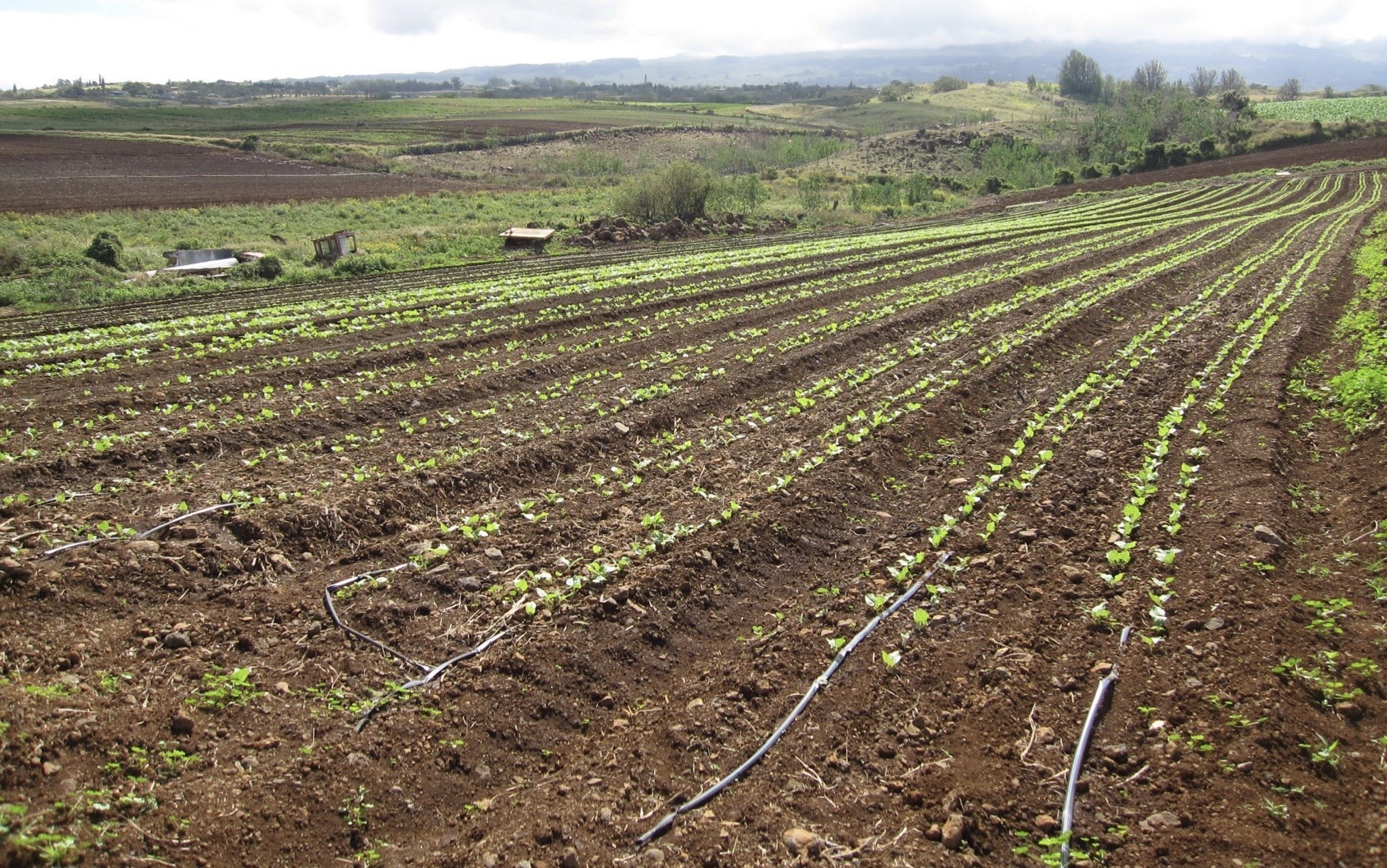
At that meeting, the recommendation of the DLNR’s Land Division stated that the 35.22 mgd for Mahi Pono “is based on the average amount of water used from January through October of 2025 for diversified agriculture, historical and industrial uses, and other uses including system losses, but excluding any water that is not used by the County of Maui, totaling (36.82 mgd), minus an additional 1.60 mgd. This amount is based on the current planted acreage of 12,734 acres. … This recommendation is in response to concerns raised by Sierra Club that Mahi Pono is planting too many acres. We note that this recommendation is to maintain the status quo during this 2026 RP.”
It adds in a footnote, “Previously, the revocable permit allowed for a diversion of 3,263 gallons per acre per day (gad) multiplied by actual acreage planted. This new calculation is based on 2,765.82 gad multiplied by current planted acreage of 12,734.”
As for Judge Cataldo’s instructions regarding the IIFS, the Land Division stated is staff “consulted with CWRM staff and was informed that the applicant’s diversion of water was compliant with the IIFS. CWRM staff also noted that the applicant was working in good faith to obtain numerous regulatory approvals to remove outstanding diversions in the Huelo region to comply with the 2022 IIFS decision.”
The Land Division also recommended that EMI and Mahi Pono should be required “to provide an improvement plan in order to implement practical mitigation measures to reduce system losses. Regarding the ditch system, staff recommends that the board require the applicant to start construction no later than November 1, 2026, on all diversion removals required under the 2018 and 2022 CWRM orders thatreceive all required State, Federal and County permits by June 30, 2026. Staff believes that requiring this work would also meet the requirement that CWRMs IIFS are implemented.”
The division also recommended that the companies provide by March 31 a plan for lining all reservoirs that store water diverted under the permit.
“Staff believes that these recommendations sufficiently comply with the
2025 court opinion requirements. Staff does not believe that the applicant must complete certain construction activities on either the diversion removals or lining reservoirs as a pre-requisite for the board to approve the issuance of the 2026 revocable permit, especially if completion of permitting requirements remains outstanding,” it stated.
In written testimony to the board, both the Sierra Club and Nā Moku ʻAupuni ʻo Koʻolau Hui took issue with many of the Land Division’s recommendations and requested a contested case hearing.
Native Hawaiian Legal Corporation attorney Ashley Obrey, who represents Nā Moku, wrote, “First, authorizing 35.22 mgd as the supposed ‘status quo’ does not maintain anything; instead, it represents a 57 percent increase over the actual average diversion of 22.41 mgd as reported by Mahi Pono and EMI to the board. This is unacceptable. The Circuit Court expressly barred BLNR from ‘allowing more water to be taken’ before CWRM’s orders are fully implemented. It is undisputed that the diverters have not completed the modifications previously ordered by CWRM, which are essential for riparian, recreation, and cultural uses of the streams as well as biological values. Staff’s proposal does exactly what the court prohibited.
“Second, the staff submittal proposes increasing not only the total the amount of water diverted from East Maui but the allocation of water to the county as well. The county does not require up to 6.25 mgd for its total domestic and Kula ag park uses. Its monthly average is 4 mgd.”
The Sierra Club’s testimony argued that the Land Division had misinterpreted EMI’s data for 2025. “The staff used data from the diversified agricultural column, but that column includes water taken from the revocable permit area as well as water from outside the revocable permit area and lots of groundwater. It calculated that the average amount of water used this year was 35.22 million gallons per day. But the court’s order does not refer to the amount of water used; it refers to the amount taken,” it stated.
“This board has already gotten in trouble with the court for making frivolous representations that were manifestly and palpably without merit. … Does it wish to increase the court’s ire by defying the court’s instructions?” the Sierra Club continued.
It pointed out that the Water Commission’s IIFS decisions in 2018 and 2022 ordered modifications to stream diversions, and called for ensuring downstream
flows in Ho‘olawa, Waipi‘o, Hānawana, Nailiʻilihaele, ‘O‘opuola, and Kailua streams.
“Yet, none of the diversion structures have been modified for these six streams! CWRM has already concluded that diversions on six streams are harming others. Until that harm is stopped, BLNR cannot allow EMI or Mahi Pono to take more water,” the group stated.
At the board’s meeting, chair Dawn Chang stated that it needed to deal with the Sierra Club’s and Nā Moku’s requests in their written testimony for a contested case hearing before taking up any substantive discussion of the proposed revocable permit to EMI and Mahi Pono for 2026.
Attorney David Kimo Frankel, who represents the Sierra Club, pointed out that the group had not yet filed the required written petition or made an oral request for a contested case hearing.
“Other people want to testify. We want to make sure we don’t cut them off. We will likely make that formal request at the end,” he said.
Chang argued that if the Land Board granted the requests for a contested case hearing, “the rest of it is moot. We can’t proceed forward on the RP.”
(In May 2024, Environment Hawaiʻi challenged the Land Board’s practice of stopping public testimony once a contested case hearing is requested. The Office of Information Practices asked the BLNR to defend this practice in June 2024; it has yet to do so. For more, see “Environment Hawaiʻi Appeals Refusal of BLNR to Hear Marconi Point Testimony,” Board Talk column, August 2024.)
Chang then asked Frankel and Obrey to explain to the board how the proposed permit would harm their clients.
Frankel pointed to the Water Commission’s 2022 finding that six East Maui streams needed more water, that the diversions were causing harm, and that the commission’s order that diversions be modified was still unmet.
“If you grant us a contested case hearing and actually act diligently, which you haven’t been doing, to commence the contested case hearing before the end of January, we will not go to court to challenge the RP during the pendency of the [hearing] as long as you do not authorize more than 23 mgd,” Frankel said.
Frankel explained that this amount would comply with the court’s order that the Land Board may not increase the amount of water taken until the modifications are made.
“So, 23 mgd approximately is what they were taking in 2025. You would be preserving the status quo. … We could take a very harsh position and say, ‘not a drop of water at all.’ We are attempting to provide you with a reasonable proposal, as we have in the past,” he said, noting that the Sierra Club’s proposed cap is similar to one the court ordered a couple of years ago.
“We’re not here to bankrupt Mahi Pono. We’re not here to have all their crops die. We are asking for a balanced solution. A balanced solution. And I don’t think you recognize what we’re proposing is a balanced proposal. What the staff is proposing is not. What Mahi Pono is asking for is not,” he said. (Mahi Pono had asked for even more water for 2026 than what the Land Division proposed.)
Chang countered that the Land Board must balance all of the interests involved, including sustainable agriculture. “How do we balance that?”
“You’re giving them 23 million gallons of water a day, which is what they used in 2025. So you’re not cutting off ag at the knees. What you’re stopping is expansion until these complicated issues are resolved,” he replied.
He later clarified that not all of that 23 mgd would go to Mahi Pono, as that amount includes the water used by the county. Subtracting the water to the county, “Mahi Pono would have available to it 19 mgd, which can be supplemented — as it has been — with water from streams that are west of the RP areas, as well as groundwater, which it has been using for the past several years,” he said.
To this, Chang said, “CWRM has taken the position that they would prefer that surface water be used” instead of groundwater, possibly referring to a recent presentation by CWRM deputy director Ciara Kahahane and staff hydrologist Ayron Strauch to the Water Commission on the difficulties of meeting all off-stream uses of East Maui water during the severe drought this past year.
Frankel countered, “The Water Commission has not taken that position. A staff member of the Water Commission took that position. The Water Commission, as you know, has never had a meeting to discuss this. We’ve never had an opportunity to cross examine anyone on this. That is not the commission’s recommendation. That is a staff member statement taken, I believe, out of context.”
The 2018 Water Commission IIFS decision approved the use of groundwater to irrigate the crops in Central Maui, and to change that position so radically could require a public hearing at least, and possibly a contested case hearing, he said.
Chang then suggested that the commission’s position is that so long as the IIFS are met, any amount of water above that could be taken to meet off-stream uses.
Frankel explained that the 2022 Water Commission finding that more water needed to flow downstream in six East Maui streams “has not been met. Currently there is a violation of the [IIFS]. You need to recognize that.”
“If the Water Commission staff, who are qualified staff, are saying that the IIFS is met …” Chang stated.
Frankel interjected, “We’re going to cross examine them on that. It’s black and white.”
NHLC’s Obrey added that she joined in everything Frankel had said. She also took issue with how the Land Division submittal attempted to address the proposed permit’s possible impacts to traditional and customary practices in East Maui.
The Land Division’s submittal cites language in the Water Commission’s 2018 IIFS decision that suggests that the record is not clear and no evidence was presented that native gathering rights were traceable to at least November 25, 1892. Yet, the commission’s decision “assumed that there are persons who can show that they possess native Hawaiian customary and traditional gathering rights.”
That limited analysis, Obrey argued, was “appalling.”
“The way that it focuses on the Water Commission decision, it brings to mind maybe, people are doubting there are traditional and customary practices in East Maui,” she said, adding that the courts and the environmental impact statement prepared for a proposed long-term disposition of East Maui water both recognize the traditional and customary practices exercised in East Maui.
She also raised the fact that the staff submittal contained no Ka Paʻakai analysis addressing possible impacts to those practices or possible mitigation.
Whatever the Water Commission’s 2018 IIFS decision says about traditional and customary practices, Obrey argued that more needed to be done to assess current effects the diversions from East Maui are having.
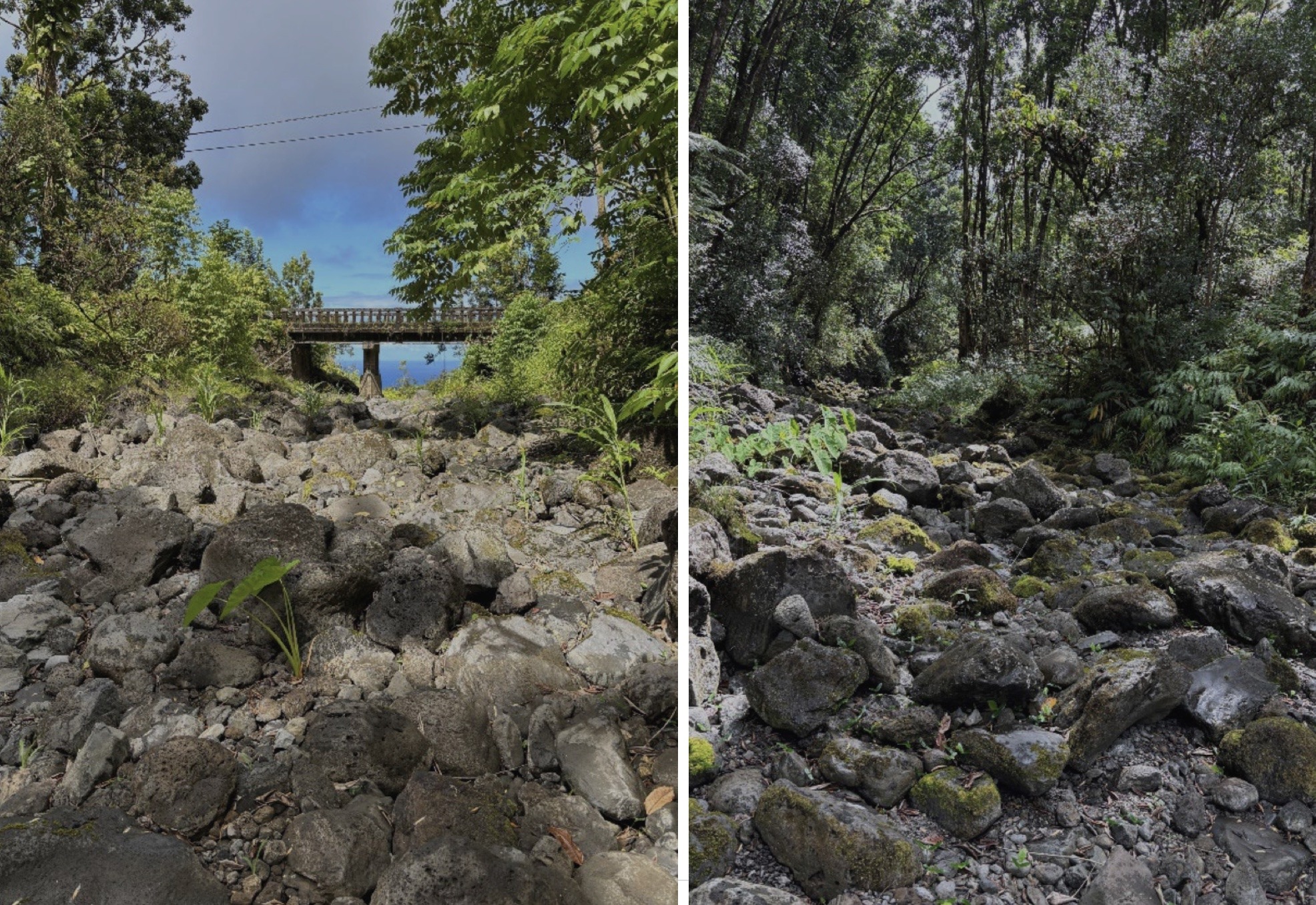
“Any time there are changes to a stream, that impacts stream life. It’s gonna impact farming. It’s gonna impact gathering. … We’re coming out of drought conditions,” she said, noting that Makapipi Stream isn’t flowing and that she’s heard from the community that Honomanu has had low flows. “To take more water out is a problem,” she said.
“Is it your position that CWRM’s conclusion that the IIFS has been satisfied is not correct?” Chang asked.“
“I’m not comfortable with that. Especially, with this recent court order,” Obrey replied.
Chang then asked both Obrey and Frankel whether they thought it was the Land Board’s role to weigh the various uses of water to determine what’s appropriate,
“So there are traditional and customary practices; there’s ecosystem. But there’s also other reasonable beneficial uses, municipal water, sustainable ag,” she said.
“You have discretion, but it’s very limited discretion,” Frankel replied. “There’s minimum standards that need to be met and have not been met. So, for example, you cannot authorize all the water to be taken from a stream. That is not balanced. Even if it provides the water to agriculture,” he said.
“Do you believe that that’s what the board has done? Authorized all water [to be taken from the streams]?” Chang asked.
“Yes. From six streams, yes,” he replied.
Chang later asked them if they disputed the Water Commission’s IIFS finding that approximately 56 mgd is estimated to be available for off-stream use at median flows.
Frankel said the board needed to recognize the larger issue, which is that 30 percent of the time, there is far less water than that. “I think it’s down to like 26 [mgd]. I don’t think Mahi Pono’s accepted that fact, which is why it’s so important they not be planting more crops now, because in the long-term, there’s not going to be enough water for their crops,” he said.
After hearing from Frankel and Obrey, the board met in executive session to discuss with its deputy attorney general their contested case hearing requests. Upon returning, Chang made a motion to deny them.
“In weighing the different government interests, including uninterrupted service to [the Maui DWS], as well as supporting ag, balanced against the interest asserted [by the Sierra Club and Nā Moku], I am making a motion to deny,” she said.
Her motion, seconded by Hawaiʻi island board member Riley Smith, passed unanimously.
‘Ketchup and M&Ms’
When it came time for the public to testify on the proposed permit, Sharon Hurd, director of the state Department of Agriculture and Biosecurity, went first.
She supported the permit and stressed the need for more locally produced food, noting that only 1.1 percent of the state’s farms have the ability to provide food for the state. “Mahi Pono would like to do their bit,” she said.
She suggested that if the world goes through another pandemic, without local farms that can produce the volume of food necessary to sustain the state, “we’re going to be eating ketchup and M&Ms, folks.”
She argued for allowing more water to be diverted than is needed, given strict crop-specific requirements. “Farming is not surgical like that [when it comes to water needs]. I’m not going to say arbitrary, it’s not surgical,” she said.
In any case, she said, “Expansion is key.”
Attorney Cal Chipchase, who represents Mahi Pono and EMI, pointed out that the county of Maui and its mayor also supported the permit with some modifications. The permit would allow the county another year to work out how its East Maui Regional Community Board might take over the job of allocating water from the diversion system.
“Alignment is nice to see,” Chipchase said.
He also supported a request by the county to increase its allocation from the 6.25 mgd the Land Division proposed to 6.5 mgd.
He then argued for raising the cap on the water Mahi Pono would receive to what the Land Board had authorized in the past, “to truly maintain the status quo.”
“We would look at what was done last year: 3,263 [gallons per acre per day] against 12,734 acres,” he said. That total of 41.55 mgd “would be perfectly consistent with the court’s order,” Chipchase said.
The order’s key word was “allow,” not what happened to be used in a year when Mahi Pono was pumping significant groundwater, he argued.
Chair Chang asked whether it was Mahi Pono’s position that it would not be expanding any crops.
“We would not exceed the allocation per acre against the number of planted acres,” Chipchase replied.
He also argued against the proposed permit condition to require a plan to line reservoirs, calling it “not the right approach.” Deciding which reservoirs to line is “a more complicated decision than saying ‘any one that takes water,’” he said.
“What is the effect and capacity of that lining?” he asked, “All of those questions are appropriate for the long-term disposition.”
He later added that with regard to mitigating system losses, Mahi Pono has already spent more than $50 million to increase efficiency, resulting in a system loss somewhere around just 5.4 percent of the amount diverted.
“I think it’s difficult to say it’s not an efficient system,” he said.
Board member Kaiwi Yoon questioned Frankel about Chipchase’s argument for using the 41.55 mgd allocation the Land Board had set in the past.
Frankel noted that Chipchase was referring to how much water the Land Board had allocated. “We’re talking about how much water was taken … which is the word that the court used,” Frankel said, before also pointing out that the board’s decision to allocate that higher amount was reversed by the Circuit Court.
“You’re instructed to not allow to them to take more than what was taken in the past. … The status quo means on the ground, not status quo that the court has thrown out,” he added.
Maui DWS deputy Kimo Landgraf testified in support of the permit as the Land Division had proposed, with the amendment to slightly increase the allocation to the county.
Maui ranchers and farmers, as well as representatives from the local food industry association and Chamber of Commerce also testified in support of the permit.
Members of Nā Moku and the Sierra Club, and others, testified in opposition.
Marti Townsend, a specialist at Earthjustice, argued that the Land Board lacked a required member who has a background in natural resource protection. “That puts a cloud over every decision you make. I want you to keep that in mind,” she said.
She also took issue with a scolding Chang gave after a chuckle erupted from the audience during Chipchase’s testimony.
“I find it really rich,” she said of the Land Board’s joking and jovial tone (a complaint other testifiers raised) “We’re not allowed to laugh or chuckle … when we’re denied an opportunity to cross-examine,” she said.
Lucienne de Naie, chairperson of the Sierra Club on Maui, invited the Land Board to come see the streams in East Maui “that supposedly meet the IIFS.”
“Come see the streams that are still waiting the mandated restoration. … We’re still waiting because of the [diversion modification] permits. They’re nobody’s priority,” she said.
To a previous testifier’s praise of Mahi Pono’s provision of cheap alfalfa bales to the island’s ranchers suffering from the drought, de Naie said, “Everybody wants the ranchers to have enough feed, to not have Mahi Pono’s trees drying. … But we need facts.”
She continued, “It sounds like you don’t want those facts. That is just really, really sad.”
She also argued that the IIFS set for East Maui may be outdated.
“We need do some of that adaptive management, to adapt to the fact we have longer droughts,” she said.
After public testimony ended, Maui Land Board member Doreen Canto said she supported the staff’s recommendation.
“It’s not an easy decision. I have ʻohana in East Maui,” she said before making a motion to approve the recommendation. Board member Smith seconded her motion, which they later amended to accommodate Maui County’s request for a little more water than the Land Division had recommended.
Canto urged the county, in working toward a solution over the next year, to work with the various parties to reach some kind of an agreement.
“Please … make sure community members are included,” she said.
With that, the remaining members of the board unanimously approved her motion. Board members Yoon and Denise Iseri-Matsubara had left the meeting by then.
Appeals
About two and a half weeks after the board meeting, the Sierra Club filed a notice of appeal with the 1st Circuit Court. And on January 5, Nā Moku filed one, as well.
In granting Mahi Pono and EMI the permit, the Land Board “violated the Environmental Court’s instructions that BLNR ensure that ‘[the Commission on Water Resource Management’s] interim instream flow standards are in place and fully implemented before allowing more water to be taken from east Maui streams,’” the Sierra Club stated in its December 30 notice of appeal.
According to the notice, the Sierra Club wants the Land Board’s December 12 decision on the contested case hearing request and permit decisions reversed. It also wants the court to modify the permit to cap diversions by EMI and Mahi Pono at 24 mgd until a contested case is completed, and to order the board to follow the instructions the court gave in its October 29 decision in the case regarding water diversion permits granted to EMI in 2022.
What’s more, the Sierra Club wants the court to sanction the Land Board for failure to comply, and to appoint a master or monitor to ensure compliance with the court’s orders.
Leave a Reply