
On April 27, 2022, at 1:30 in the afternoon, 25 members of the Hawaiʻi Legislature – 14 representatives, 11 senators – gathered to decide on the final budget of the state for the 2022-2023 fiscal year. Since it was a decision-making meeting, no public testimony was allowed.
The meeting was to thrash out differences between the spending priorities of the two chambers and come up with a conference draft of House Bill 1600. Yet if anyone watching the proceedings expected to witness debate or even discussion on the changes, they would have been disappointed.
Everything had been decided in advance. Legislative staff handed out summaries of the changes that had been agreed to. Members took turns quickly reading aloud through “highlights” of the final document.
Not even meriting mention among those highlights was a new appropriation for the Department of Education. Snuck into the capital budget for the repair and maintenance of DOE facilities was $6 million for the “Kekaha [Kauaʻi] Agriculture Innovation Center,” including land and building acquisition “and all related work including new work and refurbishment/repair/renovation.”
This had not been included in the DOE’s proposed budget. Nothing like this had ever been floated as a possibility to the Board of Education at any public meeting.
A year later, the deal was done and Beck’s Superior Hybrids was able to leave the state without taking a bath on the property it had itself purchased for nearly $6 million in 2016.
By January 2025, the Department of Education agreed to surrender the building and 10-acre lease back to the ADC for $1.
What happened?
Ambitious Plans
While the Board of Education was in the dark about the plans, the governing board of the state Agribusiness Development Corporation was well aware of this proposal. At a meeting eight months earlier, on August 25, 2021, board members had received a power-point presentation from Randall Tanaka, at the time the assistant DOE superintendent for facilities and operation.
Tanaka explained that the DOE was intending to take over the lease from Beck’s Superior Hybrids. On-site improvements included a building that housed labs, refrigeration, bays for farm implements, and offices, as well as sheds and other outbuildings.
Tanaka was asked if the DOE intended to use the facility as classrooms, for food prep or food processing, or some mix thereof.
According to meeting minutes, Tanaka replied that it would be all of the above. “They have lab space, refrigeration space,” the minutes report him as saying. The DOE’s long-range plan, he continued, “was to start on Kauaʻi at Waimea High School, which will be the quasi-owner of this classroom. They will expand to all the schools on Kauaʻi.”
“In the long term,” the minutes report him as saying, the DOE “plans to do cohorts on an international level, bring in like-minded students to Kauaʻi to see the innovation being done there.”
Tanaka described how a robotics teacher had mentioned that in Japan, “they have robots that can pick a ripe tomato, a ripe strawberry, every Ag robot you can imagine. … The labor force is maturing; this is not your grandfather’s form of ag.”
He referred to a “mega-kitchen” proposed to be built in Wahiawa, which would serve between 15 and 20 schools, suggesting that this facility would serve a similar function on Kauaʻi.
Would local farmers be able to sell their products to the DOE? Tanaka was asked.
“Absolutely,” he responded.
Rep. Amy Perruso said she had heard Tanaka speak at length about mega kitchens, referring to the Zippy’s model, where food cooked at a large central kitchen can be distributed and quickly reheated at schools. Was this what the DOE was moving toward with the Kauaʻi model – both an instructional space as well as a food hub?
Tanaka said it was both. He added that school kitchens are “antiquated” and, since COVID, schools also need to be able to serve communities, not just students.
Perruso said she just wanted to clarify that the DOE doesn’t want to renovate school kitchens but instead wants to build mega kitchens. Yes, Tanaka said. According to the minutes, Tanaka said that to renovate some of these kitchens would take from $10 million to $15 million each, but the mega kitchen would cost from $35 to $40 million, or about the same cost as renovating just five kitchens.
The ADC board approved the transfer of the Beck’s license to the DOE on a vote of 10-0.
Beck’s itself had taken over the lease and purchased the improvements in 2016 from BASF Plant Science, which had obtained a 25-year lease from ADC in 2012. That year, BASF had begun construction on the main facility, which, according to Kauaʻi County records, had a value of $6 million.
An Unused Facility
For the land itself, BASF, and later Beck’s, paid rent of just $710 a year. Yet for the Department of Education, the ADC appears to have increased the rent to ten-fold, to $7,100 a year, or $592 per month.
And while that might seem to be a fairly modest rental for 10 acres of land with improvements, the DOE apparently never paid so much as a month of rent.
Within a year of the DOE assuming the lease from Beck’s, the DOE was in serious default. By January 2024, the ADC was sending demand letters to the Department of Education.
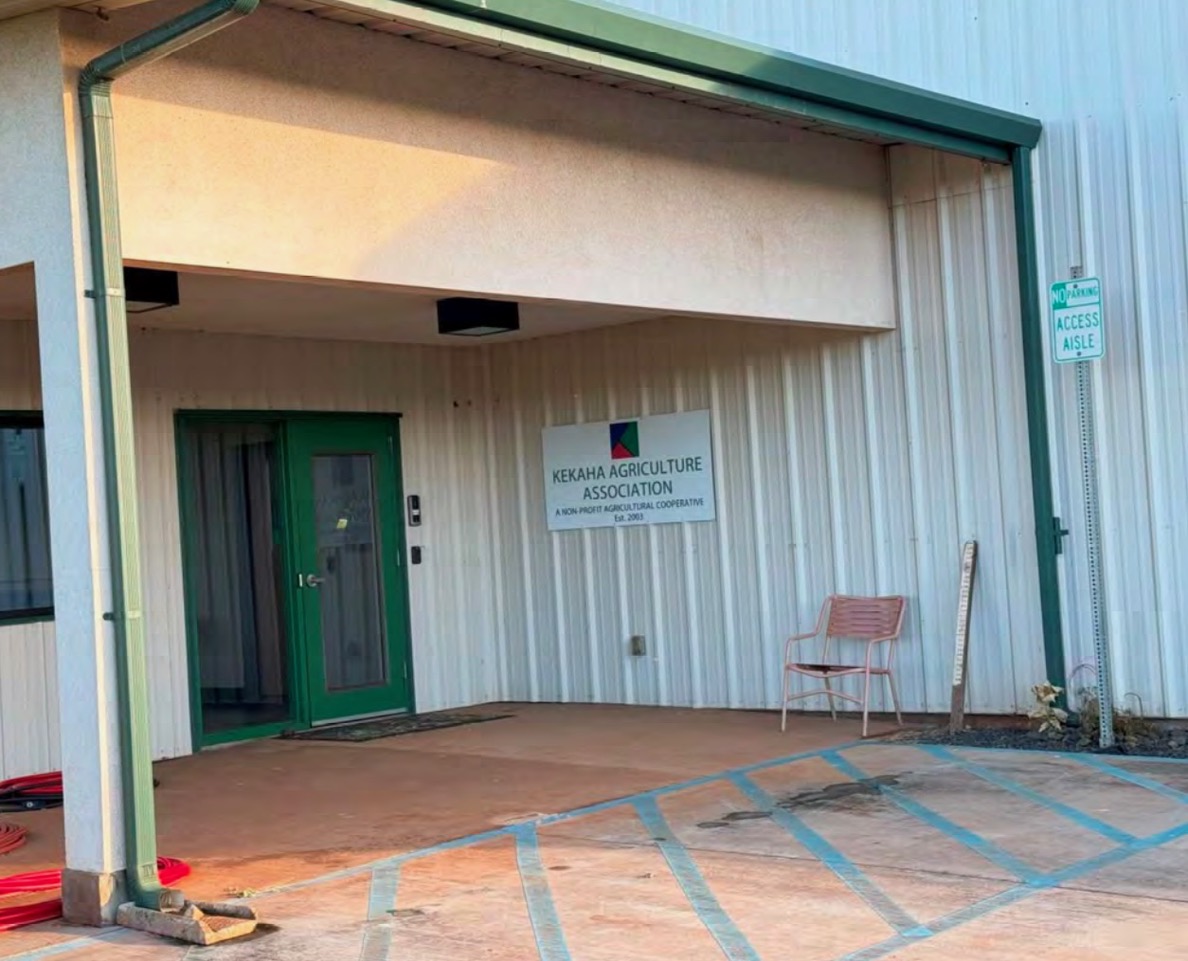
Nor was that the only problem. Terms of the lease require the lessee to obtain approval from the ADC before subleasing any portion of the property. According to an ADC staff report on the delinquency, since August 2023, the Department of Education had allowed the Kekaha Agricultural Association (KAA) to use the facility for seven months. Although the agreement had expired by February 2024, the DOE “continues to allow the use of the grounds and facilities without an agreement,” ADC staff found.
For months, the ADC staff had recommended the board refer the delinquency to the Department of Attorney General for enforcement. In March 2024, staff informed the board that despite numerous demands for payment, “no communication or payment has been received from HDOA and they maintain a $9,294.94 unpaid balance.”
At the ADC board’s meeting that month, Dane Wicker, the delegated representative of James Tokioka, head of the Department of Business, Economic Development, and Tourism, informed the board that the Legislature was discussing what should be done with the underused facility. According to the minutes, “Mr. Wicker stated that HDOE was able to get the funds to acquire the facility through the Legislature. The Legislature is in discussions with HDOE to have this facility returned back to ADC but we need to discuss more. There’s going to be a benefit to ADC by receiving a nice facility at little to no cost.”
Wicker said that legislators were discussing converting the building into a “food innovation facility for ADC” and suggested the board hold off any move to involve the attorney general. “The Legislature visited the site a couple of months ago,” Wicker is reported to have stated. “There are a lot of moving pieces that the Legislature is still entertaining. There’s talk about a potential innovation facility or making it a processing facility. This should properly be agendized at a later date.” He said that the amount owed “is not a substantial amount” and suggested “pausing it” to further consider what the “pathway” should be regarding the future of the facility.
In April, the matter was taken up once more. This time, the DOE’s Jadine Urasaki asked for another 30-day delay. Urasaki had replaced Tanaka at the DOE after he was forced out when it became known he had allowed nearly half a billion in capital improvement funds to lapse. (Tanaka went on to work as an aide to Sharon Moriwaki, vice chair of the Senate Ways and Means Committee, whose chair, Donovan Dela Cruz, has taken a keen interest in the affairs of the ADC.)
By June, the Legislature had apparently decided on a course of action. The 2024-2025 budget included $2 million to the ADC for “plans, design, and construction for a post-harvest processing center in Kekaha.”
At the June meeting of the ADC board, executive director Wendy Gady was given authority to negotiate a path forward with the DOE.
By December, the ADC was presented with a draft memorandum of agreement, calling for the DOE to surrender the land and buildings under the lease and for the ADC to forgive all arrearages and, in return, the ADC would work with the DOE to provide educational opportunities to students, using the formerly leased land and buildings.
In January, the ADC board approved terminating the lease, approved a bill of sale of the premises for $1, and a final memorandum of agreement.
“ADC will collaborate with HIDOE in developing and implementing a strategy to advance agricultural education and the pursuit of agricultural enterprises amongst HIDOE students, by providing industry-wide services that include training and new market opportunities,” the MOA states. It goes on to describe a program of collaboration in workforce training and joint promotion of agricultural infrastructure improvements on the island.
The staff submittal accompanying the MOA suggests what the ADC anticipates doing with the building. “ADC intends to fully license the premises to various farmers and agricultural-related entities for office and storage space, and processing facilities.
As of press time, the property still had not been transferred to the ADC. According to Ishikawa, “We are not yet in receipt of all fully executed transfer documents.” As to the tenancy of KAA, he stated: “We will inherit and honor whatever agreement(s) DOE has with KA as an existing tenant. ADC has already reached out to KAA to notify them o the impending change of ownership and have requested they submit in writing any request to utilize the premises.”
— Patricia Tummons
Leave a Reply